
Paolo Di Canio: Breaking the law?
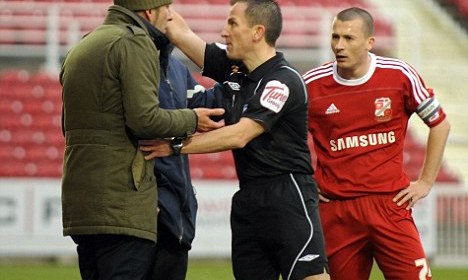
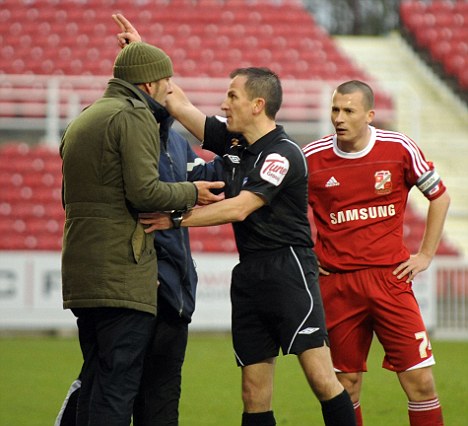
Paolo Di Canio was sent to the stands for the third time this season against Macclesfield. The incident arose following a blatant push on the back of Aden Flint, allowing Macclesfield a great goalscoring opportunity which they eventually squandered. The aggrieved Di Canio remonstrated with the fourth official, until referee Keith Stroud hastily sent the Italian to the stands.
This third dismissal follows earlier run-ins with referees against Oxford United for his goal celebration and later contesting an offside decision, followed by his second at Sixfields Northampton for leaving his technical area by some distance…
Speaking about this latest incident, Di Canio commented:
“I did not swear or say any bad words but the referee sent me off because he did not like my body language. I am a passionate man and if I want to wave my arms in the air nobody is going to stop me. If the FA charge me I will appeal because if I deserved to be sent off for that I will be in the stands every week. If they send me off 25 times it does not matter because I have a great team and we will still win the league.”
Having Paolo again reiterating that he will not change his ways, even in the face of further action from the FA following his recent £500 fine, one game touchline ban and warning about his future conduct; what rules restrict the actions of managers in their dugout – or technical area as FIFA like to call it?
Team officials such as managers, coaches and physios cannot be cautioned or sent-off in the same manner as players – on and off the field of play – and substitutes. Unlike players, who work under clear laws with seven cautionable and another seven sending-off offences, team officials within the technical area are judged under one law.
According to Law 5 of the Laws of the Game, the referee ‘takes action against team officials who fail to conduct themselves in a responsible manner and may, at his discretion, expel them from the field of play and its immediate surrounds.’ I don’t know about you but that is one of the more ambiguous and vague statements used to govern our game… yes, even more open to abuse and misunderstanding than the much maligned offside law.
First of all, who defines how one should ‘conduct themselves in a responsible manner’? With no clarification provided within the Laws of the Game, not only do managers have it open to allow them to behave as they see ‘responsible’, but equally the referee has the ability to determine as they see fit according to their personal values.
Some clarification is provided with the FA’s ‘Rules and Regulations of The Association’, however this is purely a ‘Respect Code of Conduct’ for managers – at all levels of the game – to adhere to. Importantly these do not form part of the Laws of the Game for referees to enforce. Interestingly, this respect code ambitiously asks managers to ‘always respect the match official’s decision’, however only the lifeless Sven sits passionless in the dugout without reacting to each decision.
With such an ambiguous law to implement, perhaps this is a reason for the typical power struggle between managers and referees. In the end neither has their actions fully defined in this matter, although ultimately the referee will come out on top if they want to, utilising their discretion to expel the manager from the technical area.
As managers escape formal laws governing their every action, they do benefit. Take Manchester City boss Roberto Mancini. Frequent card waving actions haven’t warranted any serious attention from the officials, yet should one of his expensively assembled squad decide to follow suit a caution should follow for ‘dissent by action’. Such contradiction between the actions of the players and managers should not exist if the law makers want to achieve real respect.
The problem facing managers, not restricted by specific word, action or behaviour, is that such ‘freedom’ can come at a cost when over-zealous referees with a failed understanding turn up to officiate.
There was no worse example of this than at the weekend when Keith Stroud took Paolo Di Canio’s flailing limbs and typical Roman assertiveness as enough justification for banishing the Italian to the stands. Taking Di Canio for his word in his description of the events, what is clear is that Paolo broke no law, no rule, in this case. It was only Stroud’s interpretation of what is deemed ‘responsible conduct’ that resulted in his unjustified dismissal. How on earth any referee can punish a manager for waving his arms in the air is beyond me…
In the end it is for our benefit that the interaction and law between the dugout and officials is seemingly as open and lax as it is. With the law makers restricting celebrations, as well as punishing perfectly timed and executed tackles – which happen to be from behind – we watch a sanitized game, largely bereft of common sense and lacking in entertainment. It is only in the dugout that the true passions of football are revealed and fortunately rarely punished… that is unless your name is Paolo Di Canio.

 The Washbag
Listen to a longer post match interview here:
http://news.bbc.co.uk/sport1/hi/football/16668613.stm
LikeLike
A manager with evid should be encouraged not punished. Wake up FA. We need more Di Canios
LikeLike
Sorry. Last post shoud read “evident passion..”
LikeLike
Referees are quick to punish PDC, seemingly for what he did all those years ago. Perhaps they forget that he also won the Fair Play Award.
LikeLike
Great article highlighting the incredibly ambiguous law that managers have to abide by. Its been menioned by others, that Uwe Roslers reaction to Huddersfields first goal was similar to Paolos, yet no action was taken.
LikeLike
There is an obvious answer here which makes use of a tool supplied by the FA themselves to youth football clubs – specifically the FA supplies ‘Respect’ barriers which are situated approximately 1 metre back from the touchlines at youth football matches and are designed to stop parents getting too close to the pitch. If these barriers were hsited around the technical area, it would be the 4th officials job to let substitutes in and out of the technical area and would discourage over enthusiastic managers from charging down the touchline or onto the pitch during a controversial incident or in celebration. These barriers are made from elaticated fabric and dont cause injury to players if they accidentally run into them… surely worth a try?
LikeLike
Great article. Those rules need clarifying..and quick, but don’t hold your breath when you consider that it’s up to the FA and ultimately FIFA to change the rules.
LikeLike
In refereeing a match, refereees clearly have a set of rules which they are there to enforce. Of course, in some cases there will be a degree of interpretation of a players behaviour/intent, but generally all is governed by ‘clear’ rules. You are asking a totally diffenrent task of a referee if he has to decide what sort of behaviour is appropriate to a manager, and they are likely to be ill-equpipped to make that judgement sensibly. Strange that the commentators on the Cardiff/Crystal Palace match this evening were laughing about how the Cardiff manager was more animated in the technical area than he ever had been as a player…… You cannot leave decisions like this to the whim of a referee/fourth official. Each one will make a different judgement in each game, with growing chaos around the country.
LikeLike
So today Paolo has been charged under FA rule E3 which states:
A Participant shall at all times act in the best interests of the game and shall not
act in any manner which is improper or brings the game into disrepute or use any
one, or a combination of, violent conduct, serious foul play, threatening, abusive,
indecent or insulting words or behaviour.
Was his actions last Saturday against Macclesfield violent, serious foul play, threatening, abusivem indecent or isnsulting words or behaviour? I don’t think so…
LikeLike