
League Two Rankings: The Defence
 Throughout this season I’ll be analysing all teams in League Two and attempting to put some reason behind League form and position.
Our rankings are divided into both defensive and attacking phases of play. Five separate measures are used within each defensive and attacking areas to rank the performance of all League Two teams. The best a team can score in each ranking set is 5, the worst being a score of 120. The two ranking scores are then added to form the overall order for League Two.
First up are the defensive rankings.
Defensive Rankings
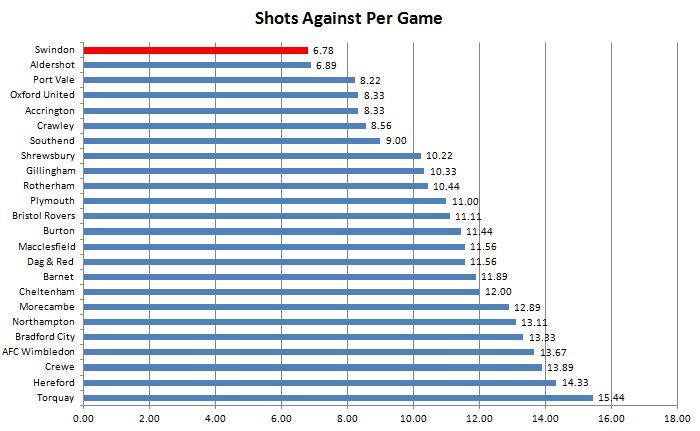
Total Shots Against Per Game
Organising the defence to restrict the number of opposition shots is clearly something Paolo Di Canio has massively improved. After nine games Swindon have the lowest average number of shots against in League Two at 6.78 per game, just ahead of Aldershot, and significantly ahead of Torquay, who’s porous defence allows an average of 15.44 shots against per game. However, as we’ll see, the Swindon defence minimising shots against is only effective if your keeper can save the limited ones they face.
Click to view
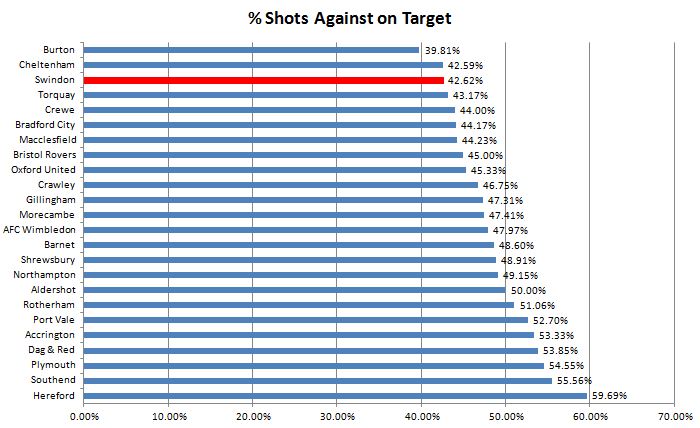
Percentage of Shots Against on Target
The total number of shots against is only part of the measure. The effectiveness of your defence to close down the opposition to reduce the number of shots on target is perhaps a clearer measure of defensive success. Again Swindon score very highly, third with 42.62% of opponent shots on target, compared to Hereford United allowing 59.7% of their shots against on target. Interestingly while Torquay allow a high number of shots against them, a very low percentage of 43.17% actually test the keeper.
Click to view
Goalkeeper Save Rate Percentage
As the last line of defence the success of the goalkeeper is obviously crucial. You may restrict opponents to 2 shots on target per game but if your opponent scores twice, clearly something is going wrong somewhere and it’s usually between the posts.
This is especially true for Swindon. Having a very effective rate of restricting opponent chances, both Phil Smith and Mattia Lanzano have so far failed to mirror the overall defensive efficiency. With a save rate of 61.5% of shots against on target, the Town keepers have the third worst ranking in League Two. By far the leader is Morecambe keeper Barry Roche with an impressive 90.9% save rate from his 9 matches. No wonder the Shrimpers find themselves top of League Two. This statistic provides further ammunition to back up both supporter’s and now Di Canio’s concerns over the quality of our stopper.

Click to view
Corners Against Per Game
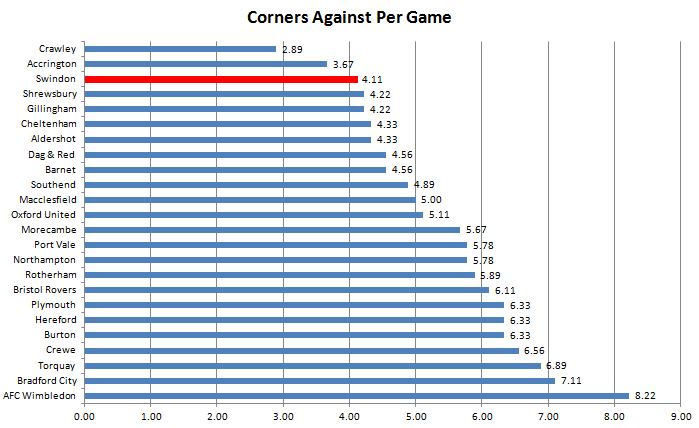
The number of corners against per game is a wider measure of restricting the attacking play of your opponents and opportunities to score from set pieces around the box. Corners against are a key indicator of the robustness and calmness of defenders, willing to clear the ball to the midfield rather than play the simple move to knock the ball into touch. The number of corners is also a measure of the attacking pressure high up the pitch, which if defended effectively, the number of corners should be low.
Again, Swindon perform very well, restricting opponents to 4.11 corners per game, perhaps a reason why our opponents find limited overall chances at our goal. As for AFC Wimbledon, 8.22 corners conceded per match is a lot of pressure to be under.
The analysis proves there is a direct correlation between the higher number of corners conceded and a higher total number of opposition shots / chances at your goal. Validating the inclusion of corners against in these rankings.
Click to view
Opponent’s Possession
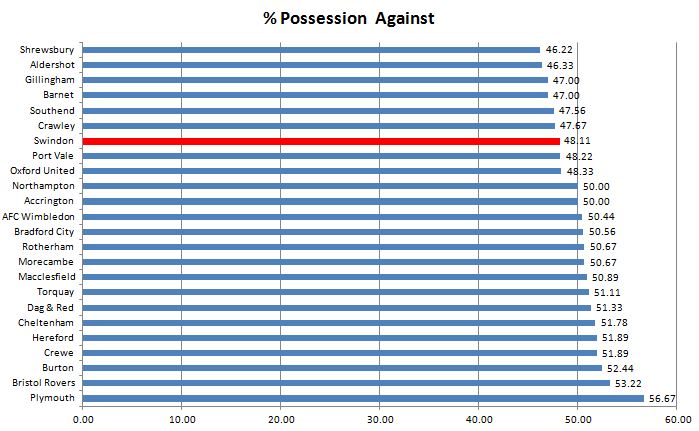
While counter attacking moves are frequently a key outlet for scoring goals, generally restricting your opponents through controlling possession is no better way to reduce opponent chances.
In restricting our opposition to an average of 48.1% possession Swindon haven’t really dominated games this season, falling within a top group of 9 clubs who control more than 50% of their matches so far. Of these 9 sides, only 3 are currently in the top 7, but 6 of the 9 are within the top half of the League table.
In truth no League Two sides have controlled games on a consistent and dominant basis, highlighting the fairly equal standard of the division in this respect.
At the other end Burton Albion prove giving away possession doesn’t preclude taking your chances, hence their 4th place in League Two. Plymouth are useless…
Click to view
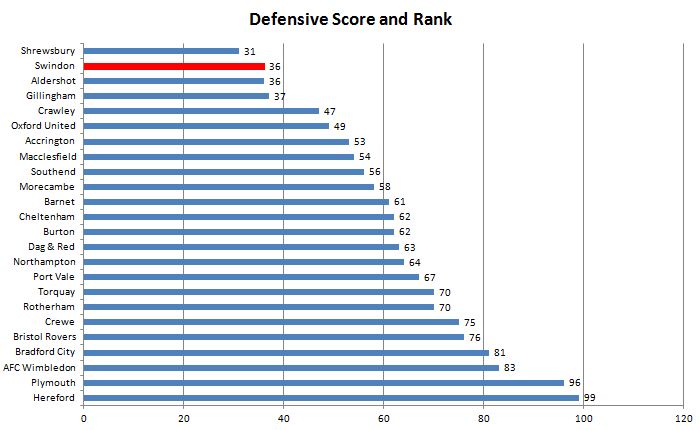
Defensive Score and Rank
Adding together all of the ranks from the five statistics, Shrewsbury Town are by far the best defensive unit in League Two. This is despite the Shropshire side sharing the third lowest total goals conceded, behind Morecambe and Aldershot.
To my surprise Swindon sit equal 2nd with Aldershot, some 22 points better off than League leaders Morecambe. As mentioned our defence is more than a match for the remainder of the division, however individual mistakes and the inefficiency of both keepers failing to save a high percentage of the shots they face have cost us vital points. No clearer than against Burton Albion on Saturday.
With Morecambe, they give away an average amount of possession and corners every game. as well as allowing a fair share of shots, however what this analysis shows is how much they rely on the ever dependable Barry Roche in goal. If Roche suffers a downturn in form, we should expect Morecambe to fall away from the summit of League Two.
The other notable club is Rotherham, who sit joint 17th with Torquay United in these defensive rankings. The Millers are clearly walking a defensive tightrope, masking their good start to the season seeing them rise to 2nd. This ranking coupled with the weekend 3-3 draw at Torquay, 3-2 defeat by Swindon a fortnight ago and only 2 clean sheets this season prove manager Andy Scott right in these post match comments following their draw at Plainmoor.
The defensive scores of Plymouth and Hereford only serve to reinforce their awful starts to this season.
Click to view
CHECK BACK TOMORROW FOR THE LEAGUE TWO ATTACKING AND OVERALL RANKINGS
The data is collated from the Press Association statistics published on the BBC.

 The Washbag
Wow! That is superb work. And useful work, once I can wake up enough to understand it all.
LikeLike
What a long-winded way of saying that you think Swindon should buy Barry Roche!
As for us (Wimbledon) I will be very happy to finish above Plymouth and Hereford with our inexperienced and porous defence.
LikeLike
If only we could sign Barry Roche to solve our goalkeeeping woes, although I doubt they’d let him leave on loan, let alone to us.
LikeLike
blinding informative and unbiased figures there – never thought I’d see Gillingham rank that well defensively after the lst few seasons, I guess our new signings and change of management are begining to work in our favour.
LikeLike
Cheers. Same with Swindon, I’m keep blinking, thinking it’s a dream seeing us joint 2nd in a defensive rank.
LikeLike
I’m going to have to change my view slightly on whether to blame STFC keepers.
I’ve looked at how good the teams we’ve faced this season have played against us.
In our 9 games, our opponents have converted 16.4% of their chances. This would be eqivelent to around 4 or 5th most clinical finishes in League Two this season.
So perhaps (other than Lanzano on Saturday) we have just faced good strikers who take their chances.
LikeLike
Cracking stuff. Would love to see the championship comparison stats.
Other stats would be the pass completion rate of opponents (how much do your team pressure the opposition into errors). Also, interesting to see whether how settled the back 5 is correlates to how well they rank.
Once again, well played.
LikeLike
Pingback: League Two Rankings: Attacking and Overall After 9 Games « The Washbag
Really good blog, loved the comparisons.
We do a lot of work with an SIS official data feed over at http://www.kickoff.co.uk
Give us a shout if we can help.
LikeLike
Pingback: Match Preview: Swindon v Barnet « The Washbag
Pingback: League Two Review: Bristol Rovers and Plymouth defy the odds to win « The Washbag